Whatever happened to Scoop & Save?
And could it make a comeback?
As a student in the early 90s, I loved Scoop and Save. I was always on the lookout for a bargain and some strategy to save enough money for a pint (or six). So, as a vegetarian and self-confessed chocolate raisins addict, I loved to splurge my grant on pulses, pasta, pistachios and paprika.
The big red bins, with scoops attached by chains, just felt like good value. You’d collect your hoard in a tiny plastic bag, trying not to spill any on the floor. Remember the days when we thought our only problems were the loss of ozone, acid rain and deforestation? As long as we weren’t wasting trees on paper bags then plastic seemed the greener option. And nobody questioned the reusable option: the plastic moulded tub.
I tried not to dwell too much on the practicalities of best before dates or how, if ever, the bins were cleaned out. I’m not casting aspersions, well maybe I am, but when I describe these vessels as ‘bins’ I’m not kidding. They were basically dustbins with perspex lids. It wasn’t uncommon to find red lentils in your rice, white pasta in your wholemeal and I daren’t think what else. Customers’ increasing concern with hygiene and cross-contamination made life difficult for independent shop owners, but it was the changes in regulations that made it impossible.
The Food Safety Act of 1990 and The Food Safety (General Food Hygiene) Regulations 1995 required food businesses to provide proof they had taken every reasonable precaution to ensure the food was safe. The difficulty for a Scoop and Save outlet was providing proof for every critical point. Essentially every single bin.
The new rules loomed over Scoop and Save with a triple threat:
- Cross-contamination – A customer using the peanut scoop for the flour bin could cause a life-threatening allergic reaction.
- Physical contamination – The open-top nature of the bins meant it was impossible to prevent contact with dust, hair, or even foreign objects (like a button falling off a coat).
- Cleaning – The requirement for containers to be easy to clean and disinfect. This not only meant regular emptying of the bins but sterilising every ridge and corner.
For any stores that had survived to the early 2000s, the HACCP (Hazard Analysis and Critical Control Point) Regulation 2006 was the nail in the coffin.
Tracking opening dates, cleaning schedules, and temperature for every bin was just too much paperwork for the independent shop owner. Shops like Julian Graves, and later Grape Tree, had no such issues with pre-sealed bags of wholefood classics like lentils, dried fruit and nuts.
But the story doesn’t end there. In the 2010s refill shops began to spring up in our high streets. Growth was slow and steady. Then came the Blue Planet boom.
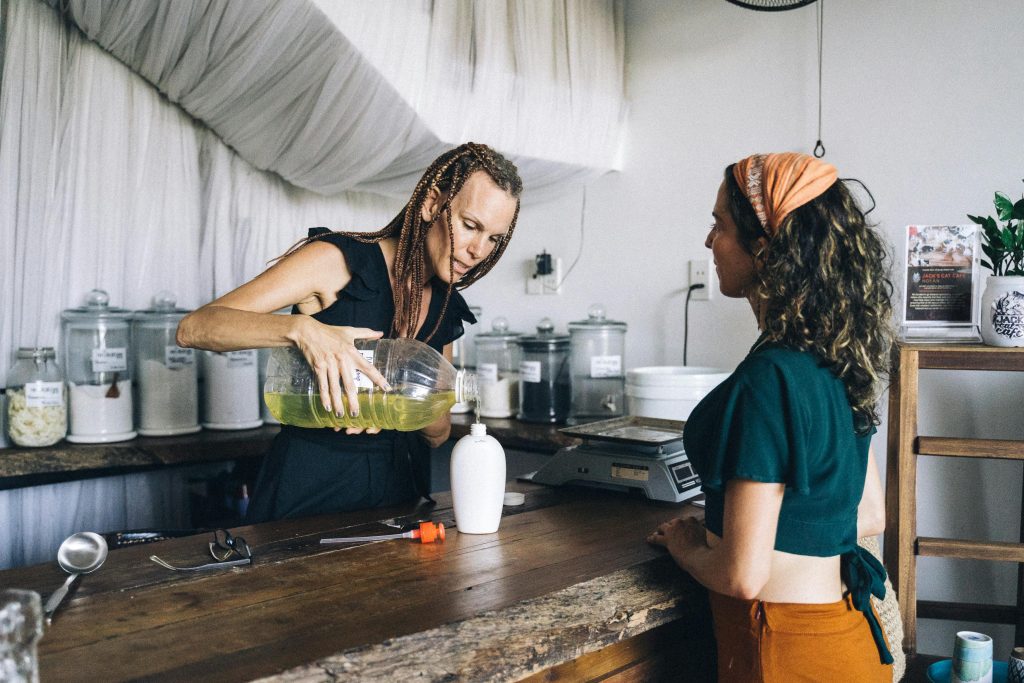
Photo by Anna Tarazevich : Pexels
Following David Attenborough’s harrowing depiction of the state of our oceans, the British public’s nostalgia for scooping was suddenly replaced by a modern environmental necessity. This shift in conscience sparked a retail renaissance, as the Scoop and Save blueprint was dusted off and redesigned for a plastic-conscious generation.
Today’s zero-waste stores are barely recognisable from their 1990s cousins. Bulk bins have been replaced with gravity dispensers, eliminating the contamination and hygiene issues. Plastic bags have been replaced with paper ones (if any at all), and plastic tubs with customers’ own containers. Today’s refill shops are more attractive too – there’s no denying it. Even the waist-high tanks of detergent, labelled in scribbly Sharpie, scream of thrift and hippy chic. Gravity dispensers are the shiny optics of the dry food vendor. Hold your washed-out jam jar underneath and watch your lentils come pouring out, like a payout on the slot machine. Everyone’s a winner. Almost.
If you can resist the colourful appeal of beeswax wraps, felted baskets and bamboo socks, then you can even save money on your weekly shop. But, how can a small independent outlet compete with supermarket prices? By employing buying collectives, avoiding packaging taxes and buying directly, little shops stand a chance. But the sums still don’t add up. Some costs can’t be negotiated – utilities, rent and wages. For the latter there is an alternative. Volunteers. In return for a commitment of a few hours a month, volunteers often receive a discount. It’s a pragmatic trade-off that keeps the lights on and the lentils affordable. In this model, the shop becomes a cooperative effort – a shared resource where the profit is redistributed back into the community’s pockets.
The red plastic bins may be gone, but the spirit of save is very much alive.