Seven years of plastic promises
What the data from the Global Commitment tells us about corporate plastic reduction
In 2018, The Ellen MacArthur Foundation (EMF) and the United Nations launched The Global Commitment 2025 – a voluntary contract with some of the world’s largest companies promising to radically rethink their relationship with plastic packaging.
114 companies – including Coco-cola, PepsiCo, Unilever, Mars, Danone and Nestlé – committed to reducing their consumption of virgin polymers (plastics made from fossil fuels) and to increase their investment in packaging that can be reused and recycled. 1200 organisations are registered in total, the remainder being endorsing signatories such as governments, universities, banks and environmental groups. Here we have the producers, regulators, funders and scientists all in one room. In effect, the commitment is a 7 year experiment to answer the question “Can big business be trusted to combat this problem voluntarily?”
Why would companies sign up at all?
Once signed up, the 114 are pledging to disclose their plastic footprint in regular submissions of data that will form the structure for EMF’s annual reports on the commitment. If a company signs up but fails to report data or consistently misses targets, they can be evicted from the group – potentially a PR disaster. So why join the commitment at all?
- Many companies are incentivised because it is looked upon favourably by financial institutions whose customers are increasingly concerned about investments’ green credentials.
- Corporate sustainability is a game of copycat. If a competitor commits then a company will feel an obligation to follow suit. If Coco-cola signs up, it’s hard for PepsiCo to say no.
- The ‘green halo’ is great for marketing. Which board member, potential partner or client would not be impressed by the claim ‘We have committed to 100% recyclable packaging’?
- Reputational accountability cannot be underestimated. Companies join for their perceived legitimacy and trustworthiness among stakeholders.
- Possibly the most powerful reason to join is that the sector wants to prove that they do not need legislating, that this is a problem they can solve themselves, voluntarily.
The headline numbers – and what they hide
Since the start of the commitment, a report has been produced every year. The most recent report was published in November 2025. It covered the data from 2024. So how did they do?
In the 2025 report, the 114 cut their virgin polymer consumption by 6% compared to 2018 figures. This is a huge leap from the previous year, where the group only managed a 3% reduction. However, the world as a whole has increased their virgin polymer use by 13% over the same period.
These figures suggest a favourable result for the Global Commitment signatories, but two notable facts are hidden behind these numbers.
Firstly, the 114 companies reduced their virgin polymer consumption by 6% on average. If you look at the individual figures, you will notice that some of the largest companies – Coco-cola, PepsiCo, Mars – have increased their virgin consumption by 10%, 8% and 11% respectively. This means these stragglers are being propped up by other companies that are drastically cutting virgin plastic production and turning increasingly to reusable or recycled packaging. Of these, SC Johnson (Method, Glade, Windex) is the front runner reducing its virgin polymer use by 33%, followed by Colgate-Palmolive who have reduced theirs by 25% and developed the first recyclable plastic toothpaste tube, and Henkel (Persil, Schwarzkopf) reducing by 24%. These winning household signatories prove that growth is not directly related to plastic use.
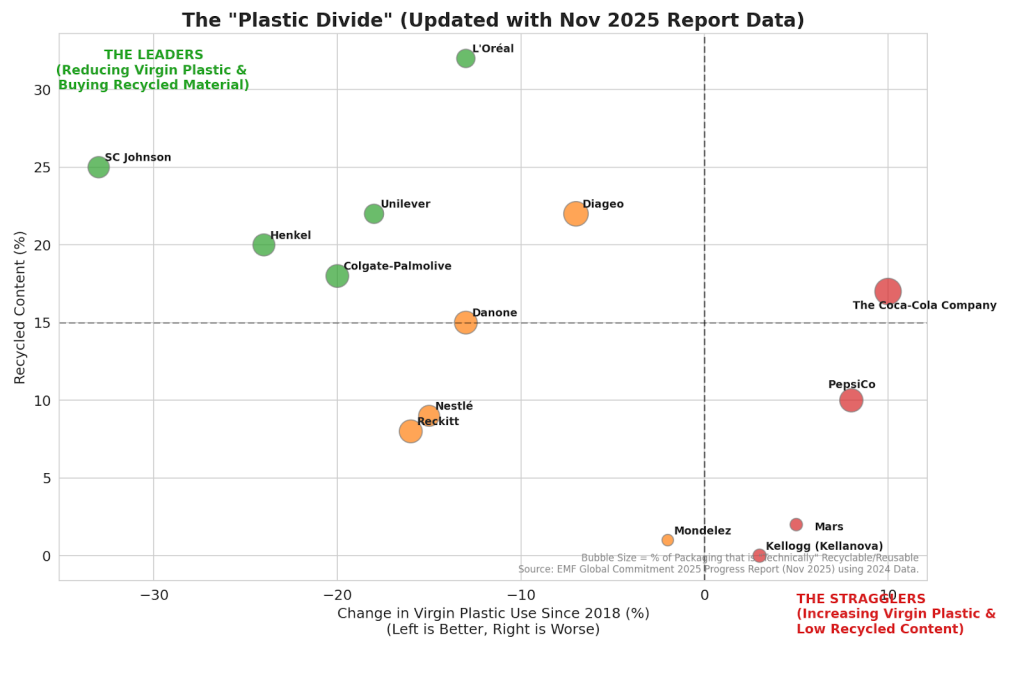
The other subtext in the above statement lies behind ‘the world as a whole has increased their virgin polymer use 13%.’ So, the 114 are on average reducing their consumption by 6% and the rest of the world are increasing theirs by 13%? That sounds bad for the ‘rest of the world’ but the truth is worse than that. These figures are for the whole of the world, so it includes the 114. Without these companies bumping up the average, the figures would be far worse.
While the figures for the global commitment members look fair, the American chapter of this story is falling apart. In mid 2025, giants like Walmart and Nestlé quietly quit the US Plastics Pact (the local version of this commitment).
The US pact included a promise to make all packaging 100% recyclable by the end of 2025. Besides the challenge of making plastic packaging recyclable at all, there is also the question of capacity. If kerbside recycling doesn’t exist for your ‘recyclable’ packaging for 30% of consumers then the US pact says it isn’t recyclable. The science might allow you to melt it down and make something new, but if it can’t be collected then it doesn’t count. It was this lack of infrastructure that made it impossible for the companies to commit.
The report shows a frenetic race towards recyclability. But, as the Ellen MacArthur Foundation itself says ‘We cannot recycle our way out of this’. The direction we inevitably need to turn is towards refillable containers. If we can keep packaging in use for longer then it delays the journey to its ultimate resting place, landfill.
Green innovation or green marketing?
The average amount of refillable packaging is 1.2%, but again, there is an outright winner. SC Johnson (yes, again!) is leading the way with 12%. So, how do they achieve this? In two ways:
- Concentrate bottles – by selling their products with less water and allowing customers to dilute them at home, reusing the full-sized packaging, they save transportation costs, water and plastic.
- Dissolvable pods – products such as Windex can be bought in the form of tiny pods that can be dropped into water and dissolved. As above these can save on transportation and packaging.
However, a question mark hangs over the chemistry. The skin of these pods is made from PVA, a synthetic, fossil-fuel-based plastic film that is designed to be water-soluble. While the company claims it biodegrades safely, critics argue it may pass through water treatment plants partially intact, behaving like a liquid plastic that can coat the gills of fish.
It might not be the perfect solution, but compared to its competitors who are still churning out millions of rigid plastic bottles that will be around for centuries, SC Johnson’s solution is potentially a leap in the right direction. We just need to be careful how we define the measurables, and understand that consumers are vulnerable to green marketing, especially when doing the right thing looks so easy.
This report shines a light on the eco leaders and shows us those with so much more to do. But what it highlights more than anything is that change isn’t going to happen voluntarily. We have reached the limit of what good intentions can achieve. We must force the stragglers to play by the same rules as the leaders; the only way to solve the plastic crisis is with binding laws.